
Limitation of Liability Provision Enforceable in Construction Context

Recently, our firm prevailed on appeal at the Fort Worth Court of Appeals, obtaining a holding that a limitation of liability provision in a home inspector’s contract was enforceable under Texas law.
This opinion arises from a lawsuit originally filed by Cornelius Joe Ergonis and Linda Ann Ergonis (“Ergonis”) in Denton County against William Thomas Sultzbaugh and Sharon Elliot Sultzbaugh (collectively “Sultzbaughs”), Ebby Halliday Real Estate, Inc. and Kathy Gibson (collectively “Ebby Halliday”), Lighthouse Engineering LLC (“Lighthouse”), and Paul Wood Inspection Group, Inc., Caleb Wood and James Alan Peterson (collectively “Paul Wood Inspection Group”) regarding a property purchased by the Ergonises. The Ergonises alleged that the Sultzbaughs, as the sellers of the Property, and Ebby Halliday as the realtor to the Sultzbaughs, misrepresented/failed to disclosure certain conditions about the Property. Further, the Ergonises alleged that Lighthouse misrepresented/failed to disclose certain conditions about the Property during the engineering inspection of the Property and that Paul Wood Inspection Group misrepresented/failed to disclose certain conditions about the Property as the home inspector. The Ergonises hired both Lighthouse and Paul Wood Inspection Group. Our firm represented Paul Wood Inspection Group.
Prior to Paul Wood Inspection Group’s inspection, Joseph Ergonis and Paul Wood Inspection Group entered into an Inspection Agreement that contained the following limitation of liability clause.
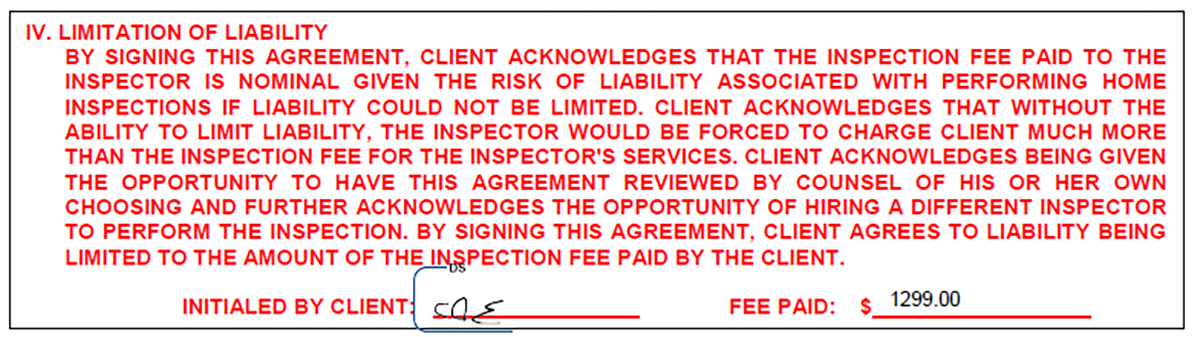
Ergonis not only signed the Inspection Agreement, but also “initialed” underneath the limitation of liability provision.
The trial court granted Paul Wood Inspection Group’s motion for summary judgment as to limitation of liability clause, ruling that the Ergonises’ recovery against Paul Wood Inspection Group was limited to the inspection fee paid, $1,299. The Ergonises appealed and the Fort Worth Court of Appeals affirmed the summary judgment.
In determining whether the limitation of liability clause was enforceable, the Fort Worth Court of Appeals reviewed existing case law in Texas. The Court found that the amount of the home-inspection fee was nominal and was reasonable for limiting liability. Next, the Court considered several factors including that the limitation of liability clause was:
– conspicuous, being set apart in the inspection agreement by being enclosed in a box, typed in ALL CAPS and in different color ink from the rest of the Agreement;
– separately initialed by the Mr. Ergonis;
– allowed for the Ergonis’ to select their own inspector; and
– allowed for the Ergonis’ to have a lawyer review the Agreement prior to signature.
The Ergonises also had a realtor and had obtained other house inspections (i.e. the inspection by Lighthouse Engineering). The Court of Appeals found there was no bargaining-power disparity between the parties and most importantly, the Court further explained that “without the ability to limit liability, the costs of home inspection services would likely increase, which might make this service unaffordable.” The Court also held that the limitation of liability clause did not exculpate a party from its own future negligence and/or injury and therefore, was not a “pre-injury release”.
This Ergonis opinion provides a helpful checklist to follow for drafting limitation of liability clauses in certain contracts and determining whether existing clauses are enforceable. It is worth noting that not all contracts or services are candidates for limitation of liability clauses due to statutes, rules, regulations or case law that may make such clauses void as a matter of public policy.
If you would like to consult with an attorney on issues presented in this article and/or how it may relate to your business needs and goals in terms of drafting contracts, and their limitation of liability provisions, the attorneys in our Austin and Dallas offices are available to answer any questions you may have. Please contact us at info@gstexlaw.com.
Legal Disclaimers
This blog is made available by Gerstle Snelson, LLP for educational purposes and to provide general information about the law, only. Neither this document nor the information contained in it is intended to constitute legal advice on any specific matter or of a general nature. Use of the blog does not create an attorney-client relationship with Gerstle Snelson, LLP where one does not already exist with the firm. This blog should not be used as a substitute for competent legal advice from a licensed attorney.
©Gerstle Snelson, LLP 2026. All rights reserved. Any unauthorized reprint or use of this material is prohibited. No part of this blog may be reproduced or transmitted in any form or by any means, electronic or mechanical, including photocopying, recording, or by any information storage or retrieval system without the express written permission of Gerstle Snelson, LLP.
