

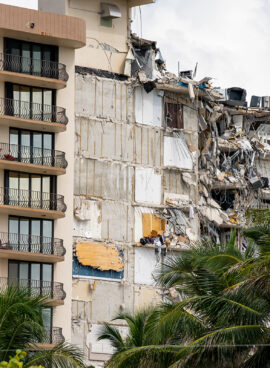
$1 Billion Surfside Settlement
On par with rarity of the collapse of a high-rise building in the US, an unprecedented $1 billion settlement agreement was recently presented to the court presiding over the property, personal injury and wrongful death claims relating to the Champlain Tower South collapse. Who contributed and the amounts they agreed to pay may surprise you.
A. The Settling Parties
The biggest contributors towards settlement are not who you might think they are or should be. As a 40+ year old building, the statute of repose had long ago cut off liability for the contractors and design professionals invo


Dallas Court of Appeals Enforces Waiver of Subrogation
Earlier this year, the Dallas Court Appeals enforced a waiver of subrogation clause in a construction contract relating to the Winspear Opera House, holding that a commercial general liability (CGL) insurance policy was “property insurance” contemplated by the contract. On behalf of our firm, I argued successfully that the waiver of subrogation barred the insurer’s claim.
In Arch Ins. Co. v. Suprema, Inc., the roofing subcontractor, Anchor Roofing Systems (Anchor), and the supplier of roofing membrane, Soprema, argued that the Arch insurance Company’s (Arch) lawsuit to recover $1.6 m


Texas Supreme Court Clarifies Notice in Construction Contracts
On May 20, 2022, the Texas Supreme Court issued its long-awaited decision in James Construction Group, LLC. v. Westlake Chemical Corp., holding that substantial compliance with notice provisions in construction contracts is acceptable, except in one instance. If the contract requires that notice be in writing, the notice must be in writing. While the James Construction opinion has other important holdings, in this article we will focus exclusively on the Court’s application of the doctrine of substantial compliance with contractual notice requirements.
The factual history of the dispute is l


The Miller Act: A Primer
The Miller Act, 40 U.S.C. §§ 3131-3134, governs performance and payment bond acquisition and claims on federal projects (that is, projects being constructed on US Government property, or for the US Government or any agency of the US Government). Unlike the many tricky provisions hidden in the Texas Mechanics’ Lien statute, the Miller Act is relatively simple to maneuver, but not without pitfalls for the unwary. Under the Miller Act, contractors on federal projects must post two bonds: A performance bond and a labor and material payment bond. A corporate surety company issuing these bonds


Feds Require Clean Concrete and Eco-Friendly Asphalt
On March 30, 2022, the General Services Administration (“GSA”) issued two new standards intended to address greenhouse gas emissions in the design and construction of federal projects. These are the first of many anticipated regulations that will be issued to reduce greenhouse gasses in the design and construction industries.
The standards apply to all GSA projects, capital and small, and regardless of funding source. For instance, they apply to paving upgrades, new construction, modernizations, and privately-financed projects. Most significantly and immediately, they apply to the $3.4
